An IoT flood warning system for Slovakia and Poland: Meratch in the LIFE FLOPRES project
A flash flood can reach a village in the Carpathian foothills in under an hour. LIFE FLOPRES, an EU-funded flood-resilience project running across Eastern Slovakia and southern Poland, exists to give residents and emergency services the warning time they otherwise would not have.
Since 2024, Meratch has been the IoT hardware partner on the ground. Our radar water-level sensors and Datanode gateway devices are installed at strategic points along the most flood-prone rivers in the Prešov Region (Slovakia) and Małopolska (Poland), feeding a Web GIS platform that turns real-time field data into actionable warnings.
- Project
- LIFE FLOPRES (Flash Flood Prediction and Prevention System)
- Funding & duration
- EU LIFE programme, €3.2 million, 3-year project
- Regions
- Prešov Region (Slovakia) and Małopolska (Poland)
- Sensors deployed (Apr 2025)
- 270+ smart devices: 176 across 3 Slovak pilot basins, 92 across 3 Polish municipalities
- Meratch's role
- IoT hardware partner: radar water-level sensors, Datanode gateways, Flow Sense (planned)
- Forecasting goal
- Around 80% improvement in flash-flood prediction accuracy versus pre-project baseline
The challenge:
Small rivers, short warning times, two countries
The north-eastern arc of the Carpathians is one of the most flash-flood-prone landscapes in Central Europe. Narrow valleys, steep rainfall gradients, and quickly saturated soils turn ordinary summer storms into events that can reach downstream villages within an hour. Roughly 12% of Europe's population lives near flood-prone rivers, and floods have caused more than €170 billion in damages and over 5,500 deaths across the EU since 1980.
The same watersheds on the Slovak-Polish border share the same risks, but historically they have been monitored by separate national systems, with different tooling and different warning chains. LIFE FLOPRES was set up to change that: one cross-border sensor network, one shared forecasting platform, and one common early-warning backbone for the communities on both sides.
On the Slovak side, the Prešov Regional Government (Prešovský samosprávny kraj) identified three pilot watersheds with the strongest flood history:
- The Ondava basin, around Svidník and Stropkov.
- The Topľa basin, around Bardejov and Giraltovce.
- The Laborec basin, around Medzilaborce.
On the Polish side, three Małopolska municipalities host the complementary rollout, giving the consortium a full cross-border picture of how storms move through the region.
It is a groundbreaking solution, a pilot, that is going to empower us with the thing that is needed the most in flood situations: time. The time to react proactively when danger is coming.
Marcela Ivančová, Mayor of Svidník
What LIFE FLOPRES is, and what Meratch contributes
FLOPRES (Flash Flood Prediction and Prevention System) is an EU LIFE project co-financed by the European Commission, worth €3.2 million and running for three years. It integrates three layers: a dense network of IoT sensors in the field, hydrological and meteorological models built on top of that data, and a Web GIS platform where authorities, experts, and citizens can analyse scenarios, simulate storms, and plan adaptation measures, including nature-based solutions and floodplain restoration.
The consortium brings together a coordinator, a hardware partner, a modelling partner, and regional authorities on both sides of the border. Meratch / GOSPACE LABS provides the IoT sensing and connectivity layer, Esprit handles hydrological modelling, and the Prešov Region and Małopolska Agencja Rozwoju Regionalnego host the deployments with their Polish partner Mateo Sp. z o.o.
- GOSPACE LABS s.r.o. (SK)
- Project coordination and Web GIS platform engineering
- Meratch
- IoT hardware: radar water-level sensors, Datanode gateways, rain gauges, soil-moisture and temperature sensors, Flow Sense (planned)
- ESPRIT spol. s r.o. (SK)
- Hydrological modelling and data evaluation
- Prešovský samosprávny kraj (SK)
- Regional authority, Slovak deployment host
- Mateo Sp. z o.o. (PL)
- Polish technical partner
- Małopolska Agencja Rozwoju Regionalnego S.A. (PL)
- Regional authority, Polish deployment host
Consortium composition per the LIFE FLOPRES project documentation.
Meratch's role:
The IoT hardware layer
The FLOPRES sensor network is multi-layered by design. Rain gauges measure precipitation. Temperature sensors track conditions that drive snowmelt and evaporation. Soil-moisture probes indicate how much more water the ground can absorb before the runoff starts. And water-level sensors track how the rivers themselves are actually responding. Meratch supplies the hardware for all four layers, plus the communication backbone that ties them together.
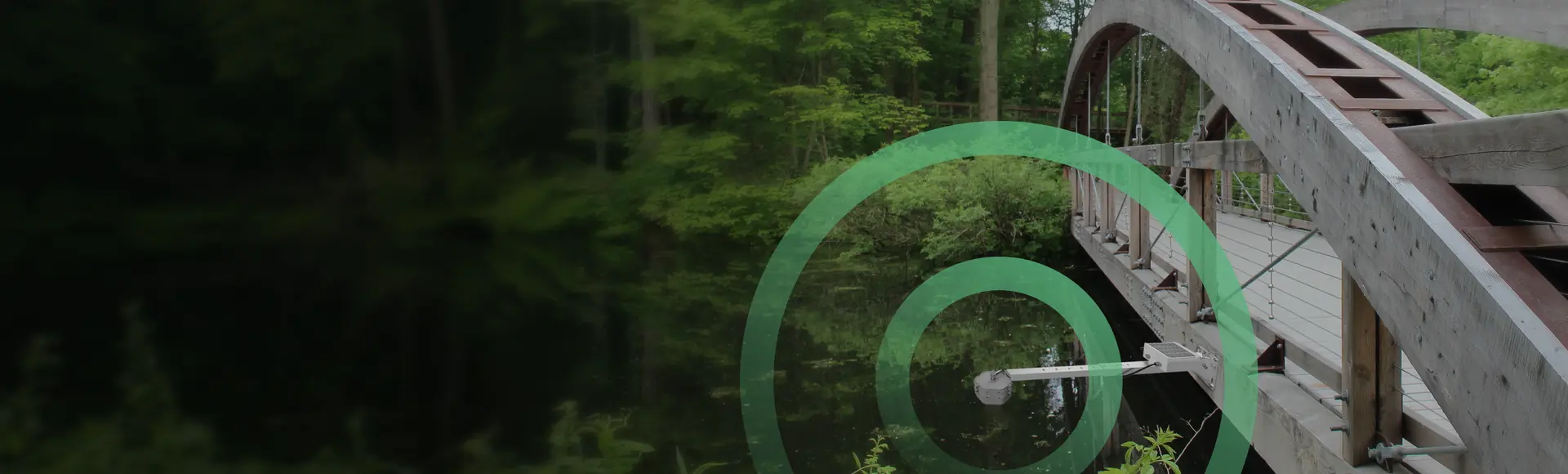
Meratch radar water-level sensors are installed under bridges and at hydrologically meaningful points along each watershed. Each sensor reads from above the water surface using non-contact 60 GHz nanoradar, so nothing sits in the flow to foul, corrode, or need cleaning after a flood event.
Rain gauges, soil-moisture probes, and temperature sensors complete the picture, capturing the hydro-meteorological inputs that drive flash-flood risk. In Małopolska alone, 71 of the 92 Polish devices cover rain, air temperature, and soil moisture.
Datanode gateways provide signal amplification, data aggregation, and multi-network transmission. They are the backbone that funnels telemetry from the field sensors to the Meratch IoT hub and onward into Esprit's hydrological models and the FLOPRES Web GIS platform. In forested Prešov valleys and remote rural sites, that redundancy matters: readings travel over LoRaWAN, NB-IoT, 2G, or satellite, whichever link is live.
Flow Sense is Meratch's flow-volume meter, planned as a future addition to the FLOPRES stack. Where water-level data tells the model how high the river is, Flow Sense adds how much water is moving through a cross-section per second. Pairing the two should let Esprit calibrate rating curves directly and tighten error bars on peak-flow predictions.
If a river level starts rising faster than the model expects, the system sees it in near real time. The difference between that and a conventional once-a-day reading is the window the mayor and her team actually needed.
- Measurement range
- 0.2 m to 22 m (customisable on request up to 23 m)
- Resolution / precision
- 1 mm resolution, ±2 mm precision (independently verified)
- Measurement method
- Non-contact 60 GHz nanoradar, 10° beam width
- Protection rating
- IP68 / IK10 (fully sealed, impact resistant)
- Operating temperature
- −40 °C to +75 °C
- Connectivity
- LoRaWAN, NB-IoT, 2G, satellite (redundant paths via Datanode)
- Power & battery life
- 3.6 V, 14 Ah (19 Ah option); up to 10 years in typical use
- Form factor
- Φ106 mm × 63 mm, 300 g, ultrasonically welded housing
- Installation
- Typical install and activation in under 20 minutes by a two-person team
Specifications per Meratch Radar Level Sensor datasheet (EN, 2025-08). Suited to the outdoor, remote, under-bridge conditions that define flash-flood monitoring.
Deployment: what is on the ground today
The first Meratch water-level sensors went live in the Slovak pilot watersheds in 2024, starting with Malá Poľana and five nearby locations in the Ondava basin. The installation times held up under field conditions: full install and activation in under 20 minutes per unit, by two-person teams.
By April 2025, at the project's halfway milestone, the cross-border network had grown to more than 270 smart sensors: 176 devices spread across the three Prešov pilot basins (Ondava, Topľa, Laborec), and a further 92 devices across three Małopolska municipalities in Poland (21 water-level units plus 71 rain, air, and soil-moisture sensors). The remaining project years focus on densifying coverage, integrating more of the Meratch stack (including Flow Sense where cross-sections are scientifically useful), and formalising the hand-off of alerts to regional and national emergency services on both sides of the border.
What this means for communities
- Residents receive flood warnings directly through the FLOPRES Web GIS platform and its public alert layer, rather than having to rely on word of mouth or delayed official channels.
- Emergency services and municipal authorities get an earlier, more specific signal of where conditions are deteriorating, so evacuation and response can be coordinated before the peak.
- Authorities, planners, and citizens can run scenarios in the Web GIS tool, including nature-based solutions like floodplain restoration, to test how the landscape would respond to different storms before investing in physical works.
- Because LIFE FLOPRES operates in both Slovakia and Poland, the warning model extends naturally across the border, where the same watersheds and the same risks continue.
Our goal is clear: to improve our ability to respond promptly and effectively, preventing damage. FLOPRES represents a significant step forward in our efforts to build more resilient communities.
Milan Majerský, Chairman of the Prešov Region
Why the model travels
Flash flooding is not limited to the Carpathian foothills. Wherever narrow valleys, steep rainfall, and small-river networks meet dispersed communities, the same risks apply, and the same combination of distributed IoT sensing and public-facing alerts can make a measurable difference. The hardware Meratch contributes, the radar water-level sensor and the Datanode gateway, is designed for exactly the conditions that make these sites difficult in the first place: outdoor installation, hard access, long service intervals, and weather that does not forgive weak hardware.
LIFE FLOPRES targets roughly an 80% improvement in flash-flood prediction accuracy over the pre-project baseline. For any regional authority, utility, or integrator asking the same question — can we see flash floods coming in time? — this is a working answer, built with hardware available off the Meratch catalogue.
Looking at a similar project?
If you are a regional authority, water management body, or integrator building an IoT flood warning system, the Meratch team can help you scope the sensing layer end to end, from single-bridge installations to a cross-border multi-watershed network.