How Bratislava Water Company Modernised Wastewater Monitoring with Meratch
Bratislava Water Company (BVS) wanted to stop estimating. At several of its most sensitive wastewater discharge points in Bratislava, the utility needed real numbers in real time, before a local event could turn into a reportable one. That was the brief Meratch took on.
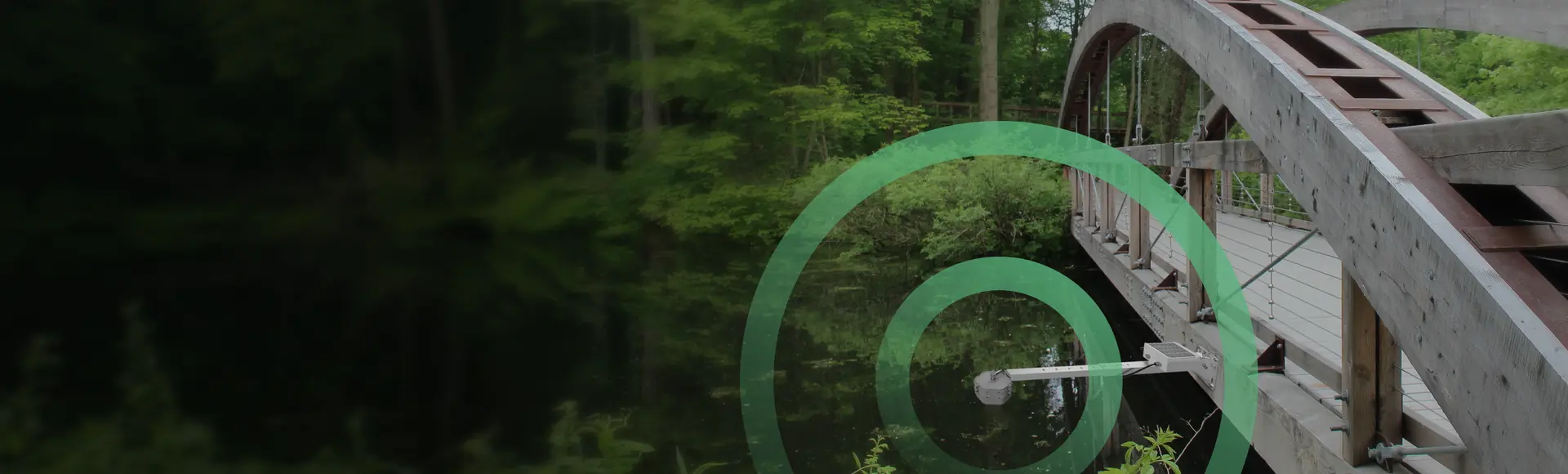
Today, the setup works like this. Meratch radar level sensors track wastewater levels continuously at multiple sites across the city. The Datanode connectivity gateway carries those readings out of underground shafts and channels where signal would otherwise be weak. And the Meratch web and mobile app gives operators one shared, live view of the network.
- Client
- Bratislava Water Company (BVS)
- Sector
- Municipal water & wastewater utility
- Deployment sites
- Podunajské Biskupice — both banks of the Little Danube; Lafranconi Bridge
- Solution stack
- Meratch radar level sensor + Datanode IoT gateway + Meratch web & mobile app
- Regulatory framework
- EU Urban Waste Water Treatment Directive (UWWTD)
- Outcome
- Continuous visibility, faster incident response, documented compliance
The challenge:
The most consequential system in the city is also the least visible
Urban wastewater works best when no one has to think about it. When it fails, the cost lands quickly: polluted rivers, regulatory exposure, and lasting damage to public trust. Bratislava is no exception. The Little Danube and the network of watercourses it feeds are sensitive to even small variations in discharge behaviour, and the city's wastewater system touches them at multiple points.
The EU Urban Waste Water Treatment Directive sets the minimum bar for how utilities across the bloc must collect and treat what moves through their networks. For a mature operator like BVS, clearing that bar has never been the issue. The harder question is operational: can the team actually see what is happening at every discharge point, in real time, with enough confidence to act, and later prove it?
Context: where Slovakia sits in the European picture
- Slovakia produces wastewater equivalent to 4.2 million population equivalent (p.e.) each day across 356 urban areas. That is roughly 0.83 million m³, or about 8 million bathtubs.
- 266 treatment plants process that load before it is returned to the environment.
- Across the EU, about 90% of urban wastewater is collected and treated in line with the UWWTD. Austria, Germany, Luxembourg and the Netherlands report full compliance. Ireland, Bulgaria, Romania, Croatia and Malta are still below 50%.
Sources: Water Information System for Europe; European Environment Agency.
Why traditional wastewater monitoring falls short
Conventional oversight leans on periodic manual checks, volumetric estimates, and retrospective reporting. In steady conditions, that is enough. In the situations that actually matter for a utility, it is not:
- Sudden rainfall events that push a network close to its hydraulic limit.
- Non-standard discharges that signal an upstream issue, whether operational, industrial, or environmental.
- Hard-to-access sites where dispatching a technician is expensive and slow.
- Covered shafts, channels and chambers where cellular coverage is patchy or absent.
Before the Meratch deployment, several of BVS's most sensitive sites fell into that last category. The data was there, but only after the fact. That is what the utility wanted to change.
The solution:
A radar-based monitoring stack designed for the real world
Meratch and BVS engineered a wireless monitoring setup that treats every discharge point as a live data source. Two in-house components do the work: a radar level sensor in the field and a connectivity gateway that carries its readings out of the underground.
Inside the Meratch radar level sensor
The Meratch Integrated Radar Level Sensor, the hardware class behind projects like BVS, is built for confined and aggressive environments. It measures from above the water surface using non-contact 60 GHz nanoradar, so nothing sits in the flow to foul, corrode, or need scheduled cleaning.
- Measurement range
- 0.2 m – 22 m
- Resolution / precision
- 1 mm resolution, ±2 mm precision
- Measurement method
- Non-contact 60 GHz nanoradar, 10° beam width
- Protection rating
- IP68 / IK10 — fully sealed, impact resistant
- Operating temperature
- −40 °C to +75 °C
- Connectivity
- LoRaWAN, NB-IoT (2G as redundant fallback)
- Power & battery life
- 3.6 V, 14 Ah (19 Ah option) — up to 10 years in typical use
- Form factor
- Φ106 mm × 63 mm, 300 g — ultrasonically welded housing
- Installation
- Multiple mounting options via adapter; typical install ≈20 minutes
Specifications per MERATCH datasheet (2025-08). The BVS deployment uses the same product line.
Datanode: keeping data flowing from underground
Accurate measurements matter only if they leave the site. Many of the points in a wastewater network sit below ground, in shafts, channels and covered chambers where public wireless coverage is weak or missing. Datanode handles that part of the job. Working as a repeater and IoT connectivity router, it carries readings from the sensor to the network and on to the platform. Without a device like Datanode, the most informative sites in a network are often the ones an operator cannot see.
One operational view, shared by the whole team
Sensor readings and alerts flow into the Meratch web interface and mobile application. Field crews and control-room operators work from the same real-time picture, not from yesterday's spreadsheet or a recollection of the last site visit. Alert thresholds can be tuned to each site and each season, so the signal that reaches the operator is the one that actually warrants attention.
Deployment across Bratislava
The solution was rolled out at several key locations in the Slovak capital, including:
- Podunajské Biskupice, on both banks of the Little Danube.
- The Lafranconi Bridge site.
At every point, Meratch sensors track wastewater levels continuously while Datanode ensures the data stream survives the concrete, the depth and the electromagnetic noise of an urban environment. What was previously a set of blind spots is now a connected, observable network.
What changed for BVS
- Continuous, millimetre-resolution measurement replaced rough estimates at the covered sites.
- Real-time notifications surface non-standard situations immediately, enabling operators to act before a local event becomes a systemic one.
- A single web and mobile interface consolidates site-by-site workflows into one view.
- Timestamped, defensible records strengthen BVS's evidence base for UWWTD reporting.
- Better visibility at sensitive discharge points translates directly into stronger protection for the Little Danube and the ecosystems connected to it.
By implementing the Meratch solution at the Bratislava Water Company, we gained immediate access to data, and in the case of non-standard situations, we are immediately notified and can take the necessary measures. In terms of regular monitoring, there has been a significant shift towards its accuracy and relevance.
Wastewater division director, BVS
Why it matters beyond Bratislava
The BVS setup is not a pilot. It is a working template for a problem most European utilities share: aging infrastructure, tighter scrutiny as the UWWTD is revised, and a climate that keeps making yesterday's assumptions less reliable. Radar sensing, resilient connectivity, and a single operational view give those utilities a practical way to respond, at whatever scale makes sense for them.
The same stack fits a single overflow point, a district, or an entire service area. What varies is how many sites you connect. What stays the same is what those sites are worth once they are visible.
Planning a similar project?
If you are a water utility, municipality, or integrator evaluating real-time wastewater monitoring, the Meratch team can help you scope, deploy, and maintain the right setup for your sites, whether that is a single overflow point or a city-wide network.