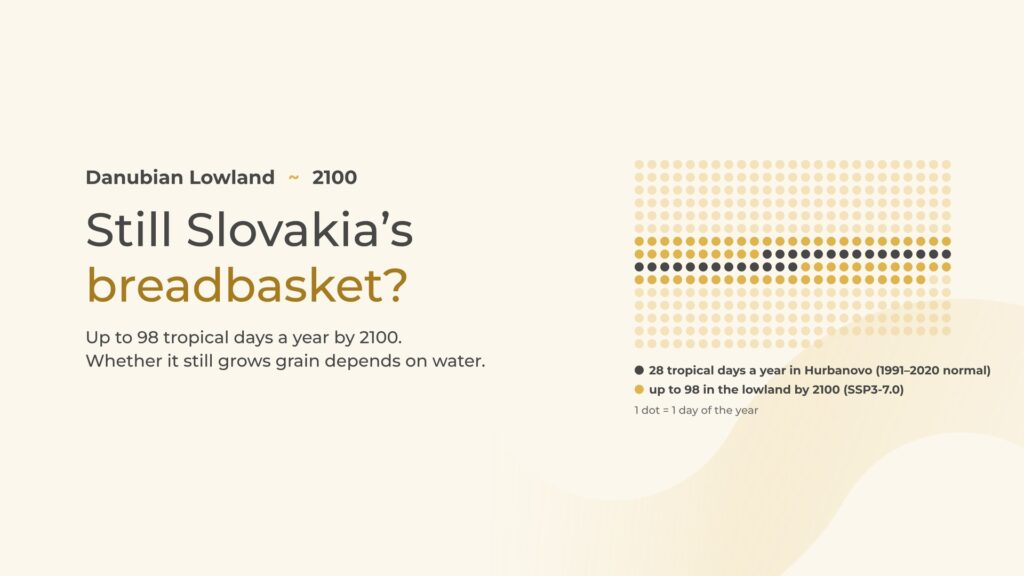
On 18 November 2026, climatologist Jozef Pecho stood in front of second-year students at the Slovak University of Agriculture in Nitra and asked them the question in the headline. These students will manage Slovak landscapes for the next forty years. The answer he gave them was a conditional yes.
Start with this year
2026 has been the driest year in Slovakia since 1961. By 13 November, the country had received 437 mm of precipitation, just 63 % of normal. April brought only 10 % of its usual rain. In the south of the Danubian Lowland, 72 days in a row passed with less than 1 mm of daily rainfall.
Satellite images of the lowland from 16 August 2026 and from the same day a year earlier look like two different countries.
The climate we plan for no longer exists
Globally, 2025 was 1.43 °C warmer than the 1850–1900 baseline. Around 2014, the pace of warming picked up from 0.17 °C to 0.38 °C per decade.
In Hurbanovo, at the heart of the lowland, the average annual temperature for 2016–2025 was 12.1 °C. For 1881–1910, it was 9.3 °C. By the standard climate classification, Hurbanovo already meets the conditions of a humid subtropical climate.
What the models say about 2100
Under a high-emissions scenario (SSP3-7.0), the projections for Slovakia at the end of the century are stark:
- temperatures 4.8 °C higher,
- a summer water deficit almost twice as large,
- the highest daily rainfall total 30 % greater,
- 96 to 98 tropical days a year in the districts of the Danubian Lowland.
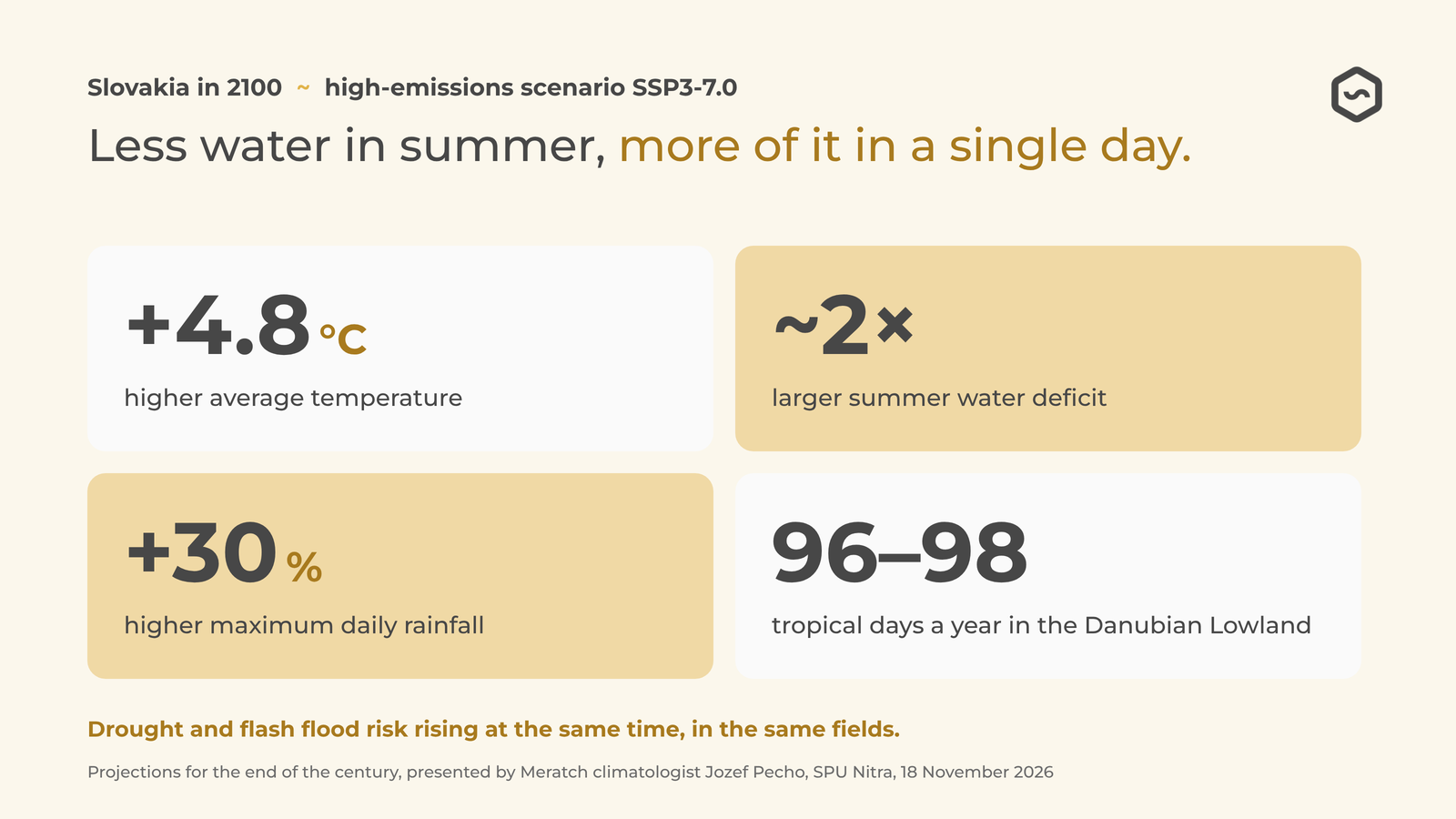
Read those last three together. Less water available across the summer, and more of it arriving in a single violent day. That is drought and flash flood risk rising at the same time, in the same fields.
Drought is now driven by evaporation
The intuitive picture of drought is that the rain stops. Today, the bigger driver is evaporative demand: a warmer atmosphere pulls more water out of soil and plants, even when rainfall is close to normal.
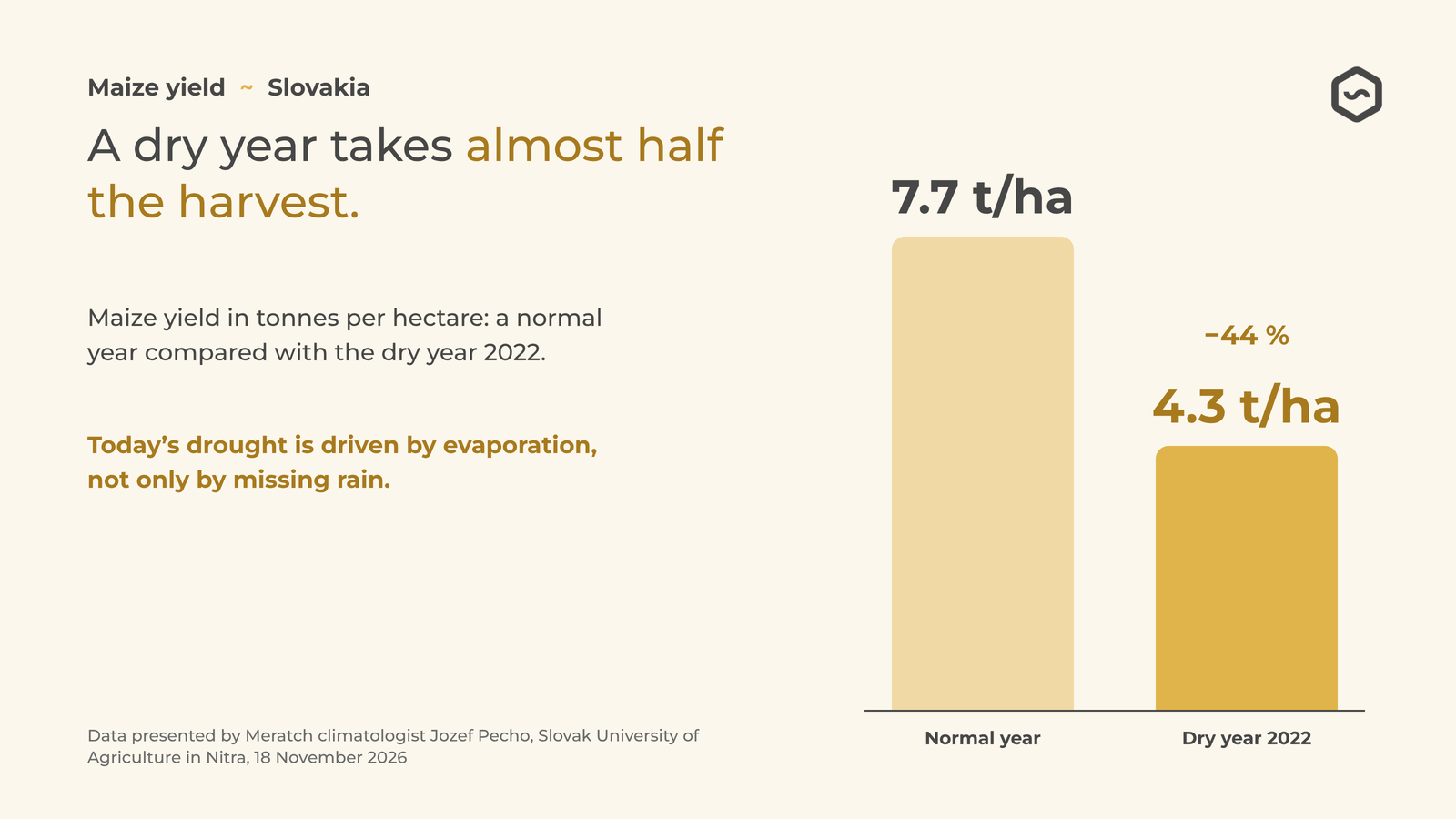
The cost is already measurable. In the dry year of 2022, maize yields fell to 4.3 t/ha, compared with 7.7 t/ha in a normal year. A dry year takes almost half the harvest.
Spring now arrives about three weeks earlier, but the risk of frost has not retreated. Plants start sooner and are caught more exposed.
What adaptation looks like in a field
The cheapest water reservoir is the soil itself. The measures that keep water there are not exotic:
- cover crops between main crops,
- keeping the soil surface covered,
- belts of trees that break the wind and slow evaporation,
- measuring soil moisture, so that decisions rest on data and not on a guess.
Slovakia’s neighbours are further along on the policy side. Czechia has a drought law. Austria covers 55 % of farmers’ insurance premiums. Germany has set measurable targets.
Agriculture is responsible for about 6 % of Slovakia’s emissions, so it is also part of the solution. Carbon stored in soil is one of the cheapest ways to remove CO₂ from the atmosphere, provided it can be measured.
Three sentences to take home
Jozef closed the lecture with three points:
- The climate we are planning for today is no longer the climate of the last century.
- Drought is caused by evaporation, not only by missing rain.
- Adaptation and mitigation are communicating vessels: one does not work without the other.
The Danubian Lowland can remain Slovakia’s breadbasket. The conditions are that we hold water in the soil and the landscape, choose the right crops, and cut emissions quickly.
At Meratch, we work on the first of those conditions every day. You cannot manage soil moisture, groundwater or a coming flash drought without measuring them where they happen.


