On 11 November 2026, at COP31 in Antalya, the World Meteorological Organization (WMO) and the UN Office for Disaster Risk Reduction (UNDRR) launched the Global Status of Multi-Hazard Early Warning Systems 2026. It is the last stocktake before the deadline of the UN Early Warnings for All initiative (EW4All), launched by Secretary-General António Guterres in 2022 to protect everyone on Earth with early warning systems by the end of 2027. At COP31, leaders backed continuing the work beyond 2027.
Where the world stands
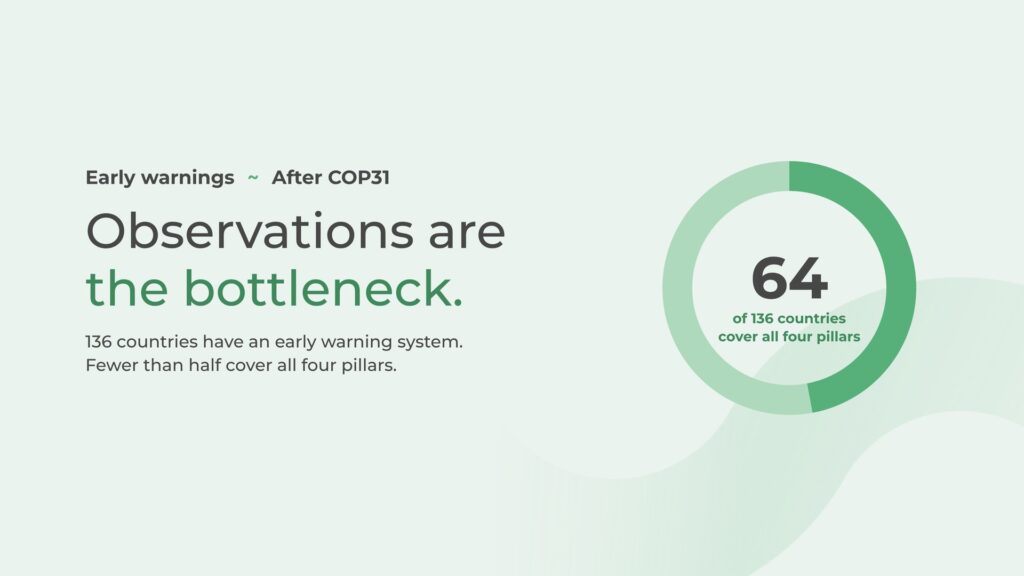
As of August 2026, 136 countries report a multi-hazard early warning system, up from 56 in 2015, an increase of 143%. That is 70% of the world’s countries and 17 more than in March 2025. Only 64 of the 136 cover all four pillars of a complete system (UNDRR/WMO).
| Pillar | Countries covering it (of 136) |
|---|---|
| 1. Disaster risk knowledge | 72 |
| 2. Detection, monitoring and forecasting | 102 |
| 3. Warning dissemination and communication | 123 |
| 4. Preparedness to respond | 111 |
For pillar 2, the report says average scores indicate comprehensive capability, but gaps remain in observation coverage, data exchange and connectivity. Countries have funding requests in the pipeline with CREWS, the Green Climate Fund and SOFF.
Why it matters
Countries with substantial to comprehensive early warning capacity have disaster mortality 6.1 times lower and 3.2 times fewer people affected than countries with limited to moderate capacity (WMO).
Lead time pays. “A warning of 24 hours can reduce damage by up to 30 per cent,” said UN Secretary-General António Guterres (WMO).
Warning is not the same as action. Four out of five people affected by disasters in the past five years received a warning, according to WMO Secretary-General Celeste Saulo. But one in three of them were unable to act on it, according to IFRC Secretary General Jagan Chapagain (same source).
The capacity gap
The bottleneck is no longer whether a system exists, but whether the national weather service can run it. Saulo put numbers on it at COP31 (WMO):
- Only 14 in every 100 weather services offer impact-based forecasts, which say what the weather will do, not just what it will be.
- Only 15 in every 100 national weather services have all the technicians they need to run and maintain their systems.
- 29 national weather services still work with an unstable internet connection.
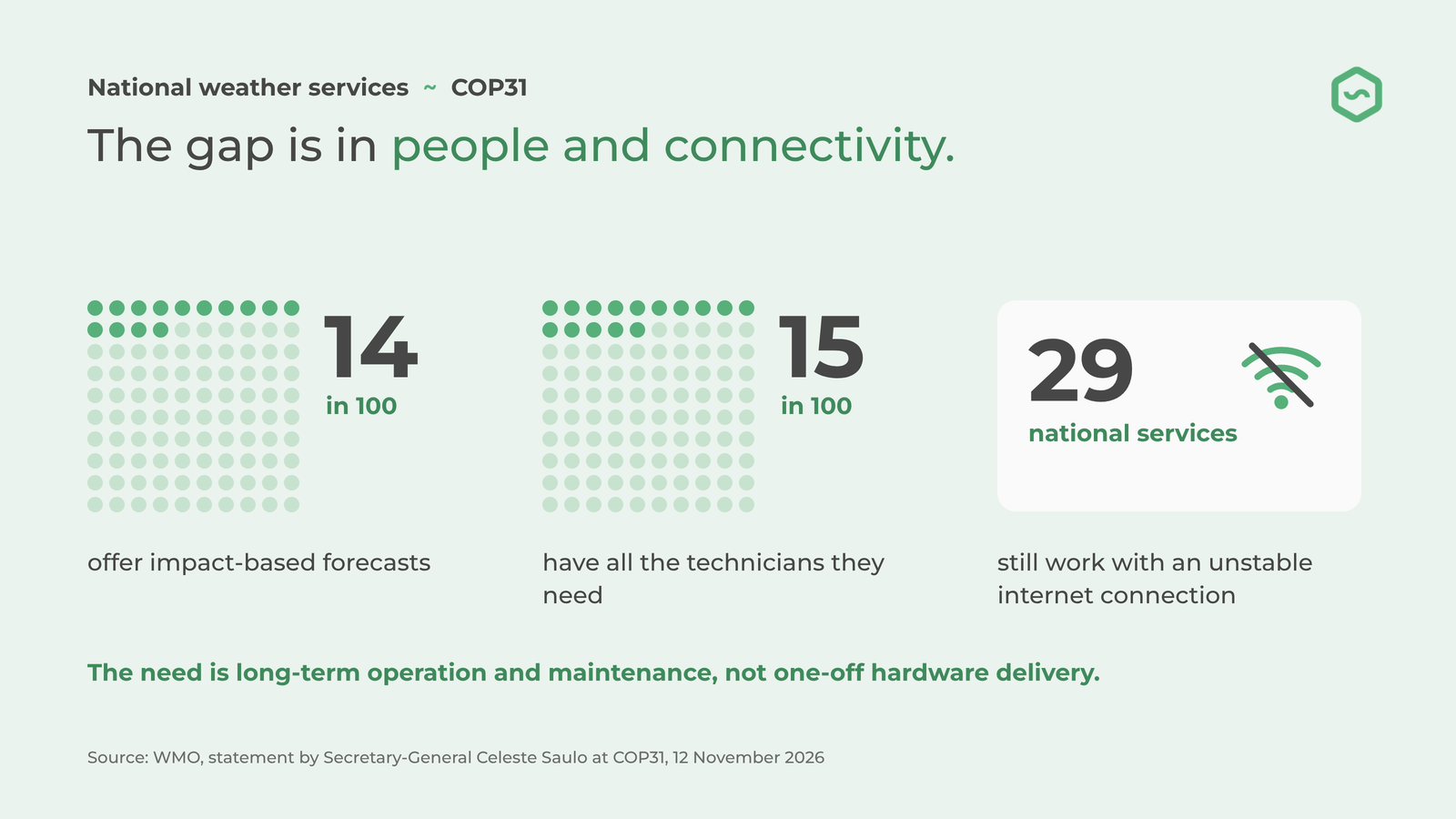
For technology providers, this means the need is for long-term operation and maintenance, not one-off hardware delivery.
What COP31 did and did not deliver
COP31 closed on 22 November 2026 without a cover decision: the proposed “Antalya pact” was rejected in the closing plenary (Carbon Brief). The draft text of 19 November shows where negotiators had converged:
- “Systematic observation underpins early warning, climate services and the assessment of collective progress”, with support for closing observation gaps in developing countries through the Systematic Observations Financing Facility (SOFF).
- A recall of the UN Secretary-General’s call for universal coverage of early warning systems for all people on Earth by 2027.
- Adaptation finance needs in developing countries are estimated at approximately US$305 billion a year by 2035.
No figure for tripling adaptation finance made it into any final text. International public adaptation finance to developing countries was US$28.2–31.7 billion in 2024 (Down To Earth, citing UNEP). The money for early warning therefore keeps flowing through existing funds rather than a new COP commitment.
Where the money flows
Funding for early warning reaches governments and their national meteorological and hydrological services through international funds and development banks. The services then procure equipment and services through tenders.
| Channel | Latest figures | Focus |
|---|---|---|
| SOFF (Systematic Observations Financing Facility) | US$152.5 million pledged; US$126 million investment phase; 23 countries approved (April 2026) | Basic surface and upper-air observing networks |
| CREWS (Climate Risk and Early Warning Systems) | France €3 million for 2026; US$2.8 billion leveraged from the World Bank and others | Early warning systems |
| Green Climate Fund | US$960.3 million for 18 projects (March 2026); portfolio above US$20 billion | Climate projects, incl. monitoring and early warning in Armenia |
| Adaptation Fund | US$133.83 million for 9 projects (April 2026); record pipeline of 94 proposals worth US$1.33 billion | Adaptation, incl. early warning |
| EU and member states | €32.3 billion public climate finance (2025); €10 million for early warning in the OACPS disaster risk programme, to 2028 | EU partner countries |
A role for the private sector
WMO acknowledges that “the private sector sometimes lacks clear entry points into WMO”. One area of collaboration it identified is infrastructure-as-a-service, where national weather services use private capabilities while keeping “continued access to and stewardship of observational data”. The findings feed into the World Meteorological Congress (Cg-20) in 2027 (WMO). The Alliance for Hydromet Development, which coordinates development finance for weather services, made “advance public-private engagement and innovation” one of its three priorities for 2027–2028 (WMO).
Where Meratch fits
Meratch works in pillar 2: detection, monitoring and forecasting. Our IoT stations measure water levels, rainfall and soil moisture in real time, and the Floodar platform turns those readings into flash flood alerts for operators and civil protection. The findings above point to three things that matter to weather services:
- Dense observation where networks are thin. Low-cost, low-power stations close gaps in observation coverage.
- Resilience to weak connectivity. Devices and data flows built for networks that are not always available.
- Long-term partnership. Operation, maintenance and data services over the life of the network, with the national service keeping ownership of its data.
If you work for a national hydrometeorological service, a development bank or an implementing agency, we would like to hear what your network needs.
Sources
- UN – Early Warnings for All
- UNDRR/WMO – Global Status of Multi-Hazard Early Warning Systems 2026
- WMO – COP31 leaders back a long-term future for Early Warnings for All (12 Nov 2026)
- WMO – Celeste Saulo statement at COP31 (12 Nov 2026)
- WMO – early warning protection expands worldwide (FR) (11 Nov 2026)
- UNFCCC – COP31 draft cover decision (19 Nov 2026)
- Carbon Brief – COP31 key outcomes (23 Nov 2026)
- Down To Earth – COP31 climate finance (10 Nov 2026)
- SOFF Fund Report 2025
- WMO – CREWS contributions (4 May 2026)
- GCF – portfolio passes US$20 billion (28 Mar 2026)
- GCF – SAP068 Armenia
- Adaptation Fund – 46th Board meeting (10 Apr 2026)
- EEAS – EU climate finance factsheet COP31
- WMO – new chapter in public-private engagement (29 Jun 2026)
- WMO – Alliance for Hydromet Development (23 Oct 2026)


