When climatologist Jozef Pecho took his seat on the opening panel of the Vizionári conference in Bratislava on 16 November 2026, he was the only person on stage who did not work in healthcare. The conference was about lungs and allergies. He came to talk about temperature.
His argument was simple: heat is the largest climate-related health risk Slovakia faces, and the country is measuring it badly.
Slovakia is warming twice as fast as the world
Between 1975 and 2025, Slovakia warmed by 0.44 °C per decade. The global figure for the same period is 0.22 °C.
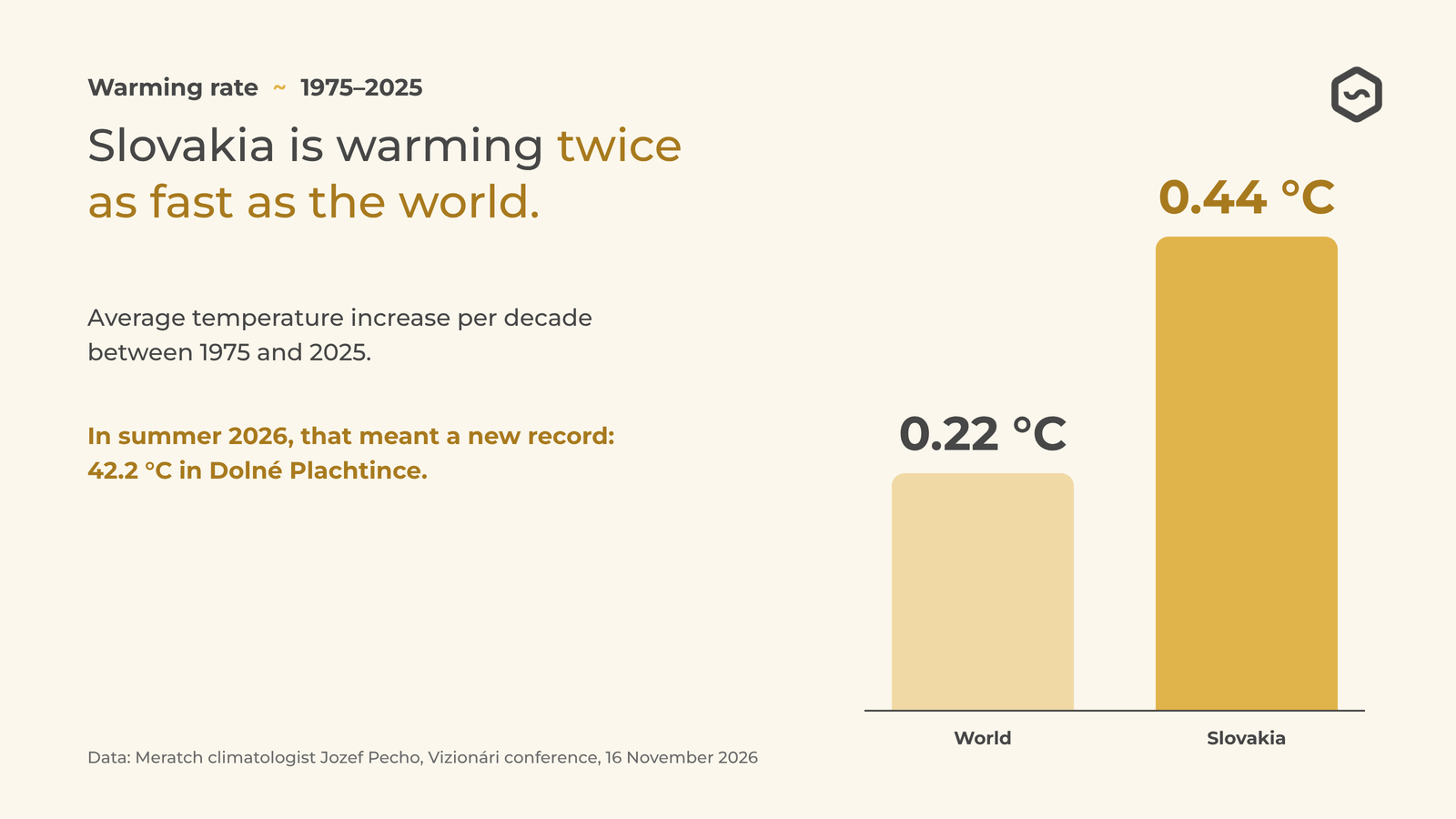
Averages, however, are not what sends people to hospital. Extremes are. The summer of 2026 brought a new national record of 42.2 °C, measured in Dolné Plachtince on 6 August. Five days exceeded 40 °C. On some nights, the temperature did not fall below 28 °C, which leaves the body no chance to recover.
According to Jozef’s own attribution analysis, climate change made the June 2026 heatwave about 4 °C hotter and at least ten times more likely.
The deaths nobody attributes to heat
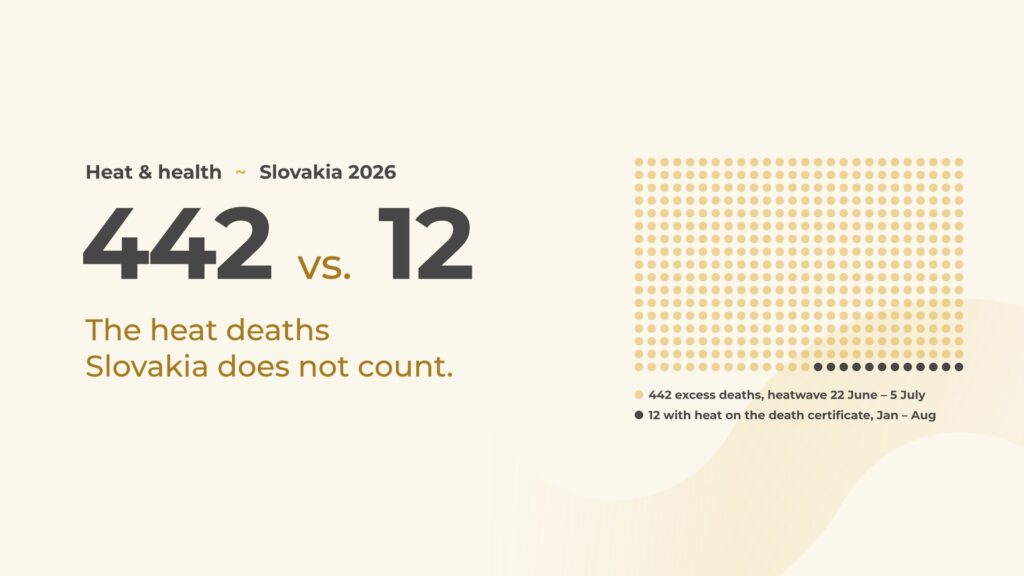
During the heatwave of 22 June to 5 July 2026, 442 more people died in Slovakia than would be expected for that period. That is 24 % above the norm. The estimate is Jozef’s own calculation, based on weekly death counts.
Now compare it with the official picture. Death certificates from January to August list heat as the direct cause in only 12 deaths.
Both numbers can be true at once. Heat rarely kills on its own. It pushes a failing heart, damaged lungs or weak kidneys past their limit, and the certificate records the organ, not the weather. That is why excess mortality is the standard way to measure what a heatwave really costs.
North and south face different risks
Slovakia is a small country with very different climates. Hurbanovo in the south has on average 27.7 tropical days a year, meaning days above 30 °C. Čadca in the north has 7.0, and Oravská Lesná just 1.4 (1991–2020 normal).
The health risks follow that map. The south struggles with heat, drought and ground-level ozone. The north faces flash floods and winter smog trapped in valleys. One thing is shared: fine particulate matter exceeds the WHO recommendation in all 79 districts.
The missing piece is linked data
Daily deaths, hospital admissions and ambulance call-outs by district are not available in one place together with temperature, ozone and pollen. Without that link, nobody can say on a given day which districts are in trouble and why.
It can be done. Spain publishes daily deaths attributed to temperature for every province.
On the panel, Jozef made a concrete offer: Meratch and the Regional Climatological Institute can supply the meteorological and climate half of that picture at district level. The health half has to come from the health system.
A warning is not yet health advice
A heat warning says that it will be hot. It does not tell a GP, a care home manager or a social worker what to do.
Slovakia needs a heat action plan: clear procedures for health professionals, cooled rooms, and specific measures for care homes and the people who look after the elderly at home. Warnings should combine heat, ozone and pollen, because patients breathe all three at once. They should also be more sensitive at the start of summer, when bodies have not yet adapted.
There is a reason for urgency. A 2026 study in Nature Health (Barnes et al.) suggests that warming may be outpacing our ability to adapt to it.
Why a water company cares about heat
Meratch builds sensors and platforms for monitoring water, weather and soil. Heat, drought and flash floods are not separate stories. They are the same warming atmosphere showing up in different places, and all of them are local.
A national average does not tell a mayor which street floods or which neighbourhood overheats. Dense, automated, hyperlocal measurement does. The same logic that gives a village a flood warning in time can tell a district when heat becomes dangerous.
The 430 deaths between those two numbers are not a mystery. They are a measurement gap. Closing it starts with putting health data and weather data side by side.


