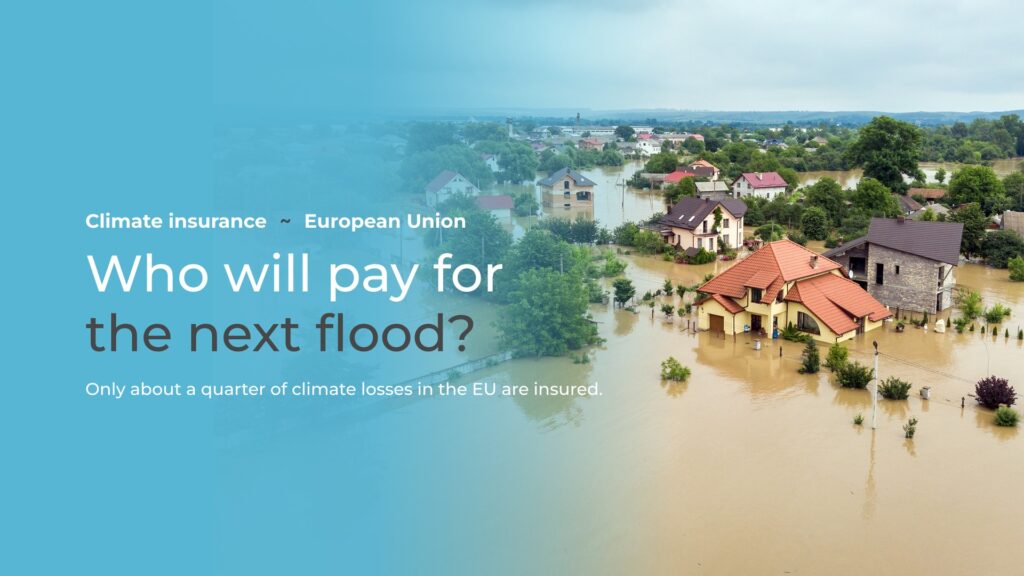
Climate extremes caused an estimated EUR 822 billion of damage in the European Union between 1980 and 2024. Historically, only around a quarter of natural catastrophe losses in the EU have been insured. The European Commission has now announced a Climate Insurance Alliance and proposed a European Climate Resilience Law.
What happened
On 16 September 2026, in her State of the Union address, Commission President Ursula von der Leyen announced a Climate Insurance Alliance to help cover the insurance gap. In the same address she announced a framework for climate resilience, a European Heatwave Plan and a European Water Initiative [1].
On 27 October 2026 the Commission presented a package of documents: a proposal for a European Climate Resilience Law [3], an accompanying Communication [2] and an impact assessment [4]. The Communication describes what the Alliance should do and by when. The Alliance itself does not exist yet: the Commission says it “will set up” the Alliance and that a first set of specific measures will follow by the end of 2027 [2].
Losses are rising faster than we respond
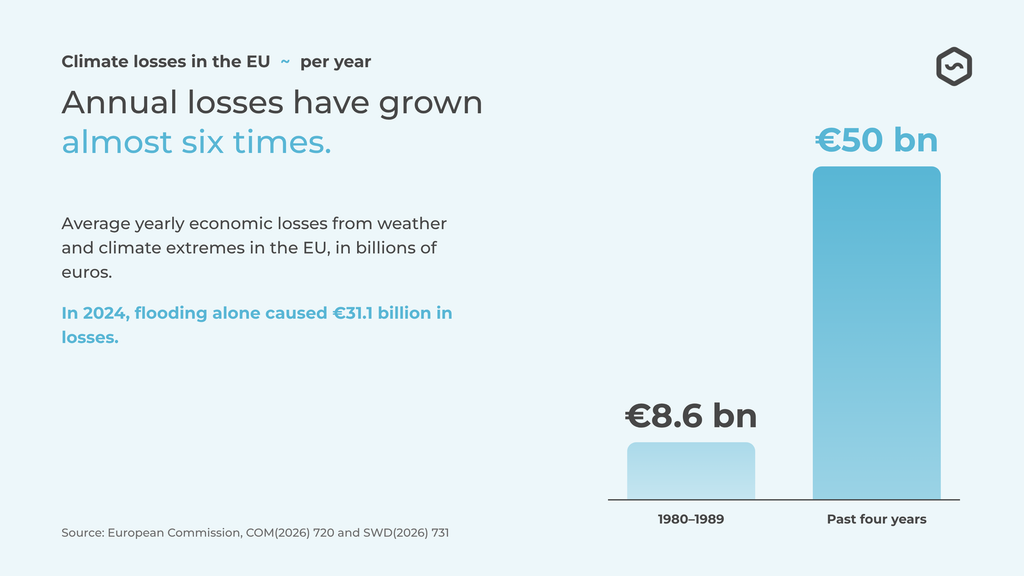
Of the EUR 822 billion in losses recorded between 1980 and 2024, about a quarter occurred after 2021 [4]. Annual losses from climate extremes over the past four years stood at around EUR 50 billion, up from EUR 8.6 billion a year in 1980–1989 [2]. In 2024, flooding alone caused EUR 31.1 billion in losses across the EU. A single event can result in severe consequences: reconstruction costs of the 2023 flash flood damage in Slovenia were estimated to represent 16% of the country’s annual GDP [4].
The Commission describes the summer of 2026 as a “summer of truth”. Wildfires burned about 700,000 hectares and destroyed 12 million tonnes of crops, and the Danube, the Rhine and the Garonne fell to critically low levels [2]. In agriculture, average annual losses in the EU are around EUR 28.3 billion, and only 20–30% of them are insured. Drought-related losses in 2026 could reach as much as EUR 90 billion [2].
Who pays
According to the Commission’s impact assessment, uninsured climate losses fall on public balance sheets. The insurance protection gap is 75% [4].
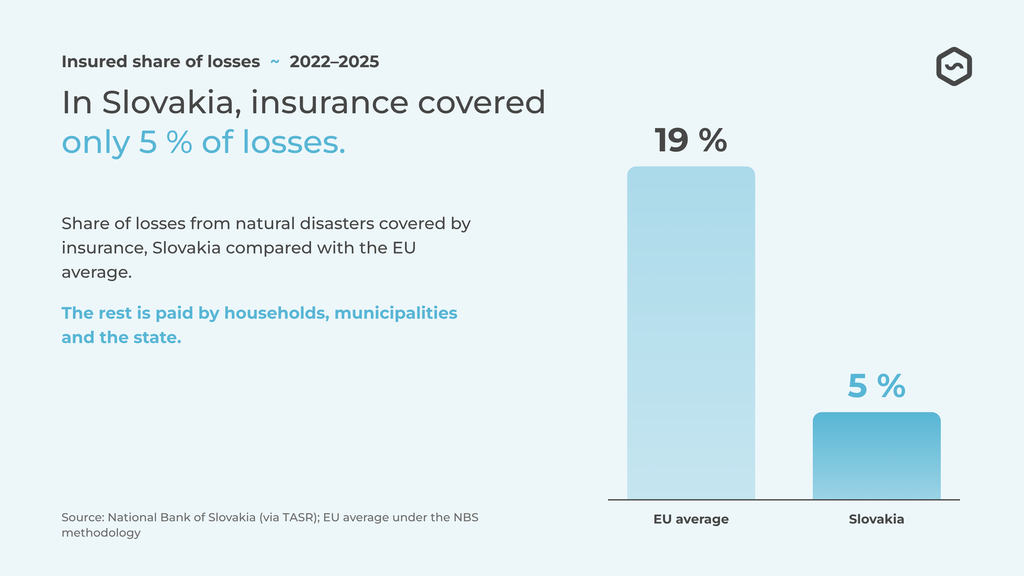
In Slovakia the gap is even wider. According to the National Bank of Slovakia, insurance covered on average only 5% of losses in 2022–2025, compared with an EU average of 19% under the NBS methodology. After a storm in Gelnica in 2025, with damage of almost EUR 1 million, the state covered about half because most of the property was uninsured [5].
In Czechia, the September 2024 floods led to about 98,000 insurance claims, and insurers expected to pay out around CZK 20 billion. According to the Czech Insurance Association, households lost a similar amount because they had no insurance or inadequate insurance [6].
What the EU proposes
The proposal is a regulation, so once adopted by the European Parliament and the Council it will apply directly in all Member States [3]. Its main elements:
- A common reference global warming trajectory: 1.5 °C by 2030, 2 °C by 2050 and 3 °C by the end of the century [3].
- Each Member State carries out a national climate risk assessment by 30 June 2029, including at subnational level where applicable [3].
- By 31 December 2030, each Member State adopts a single national strategic plan on climate resilience. It names a responsible public authority for each major climate risk and sets objectives with progress indicators and measures with costs and benefits. Regional and local authorities must have early and effective opportunities to take part in preparing it [3].
- Assessments and plans must cover 13 policy areas, including water security and critical water infrastructure, and crisis preparedness [3].
- The EU will track the share of uninsured climate-related economic losses every year [3].
The Climate Insurance Alliance is to bring together insurers, reinsurers, intermediaries, insurance takers, risk modelling experts, investors, EIOPA and public authorities. By the end of 2027 it should deliver measures to increase insurance uptake and enable quick payouts (for instance through parametric insurance), to incentivise prevention, to assess data availability and sharing for better risk modelling, and to secure adequate insurance capacity. EIOPA will set up an Observatory for Catastrophe Risk Insurability [2].
Why the past is no longer enough
The impact assessment notes that climate risks are non-linear and geographically correlated, so insurers cannot price them using historical data alone. As insurers make underwriting more complex to reduce payouts, the protection gap widens [4]. The document also finds that access to reliable, actionable data remains insufficient: some EU tools are too technical or provide information that is too coarse, and capacity at regional and local level is limited [4].
Looking ahead, expected annual damage from pluvial and fluvial flooding in Europe could reach EUR 13–29 billion in 2041–2060 if no additional policy action is taken. That is an increase of 110–150% due to climate change alone, and the number of people affected each year could rise by around 150% [4].
The impact assessment identifies early warning as one of the highest-return adaptation investments. Better information and early warning systems for flooding could limit damage to infrastructure and buildings by as much as 25%. The European Flood Awareness System (EFAS) has an estimated benefit-cost ratio of 400. These high returns depend on early warning and monitoring systems being shared, interoperable and built on common risk data [4]. As an example from Central Europe, the Commission cites Prague: flood barriers built after 2002 for EUR 146 million are estimated to have prevented more than EUR 2 billion in damage [4].
Our view: what a municipality can do today
The obligations in the proposed law apply to Member States and would take effect in 2029 and 2030 at the earliest. Municipalities, however, are paying for damage today. We see knowing about a threat earlier as a sensible first step: monitoring river levels and rainfall in the municipality itself and having access to short-term storm forecasts. In our view, such local data can complement the pan-European tools that the Commission itself describes as too coarse, and can help a municipality in discussions with insurers and when preparing funding applications. At Meratch we work intensively on hyper-local early warning for flash floods and drought and believe that even small villages should have the possibility to be warned when it is most needed.
Sources
- EU – State of the Union 2026: Quotes and initiatives (16 Sep 2026)
- European Commission – COM(2026) 720, A Resilient Europe for a Changing Climate (27 Oct 2026)
- European Commission – COM(2026) 730, proposal for a European Climate Resilience Law (27 Oct 2026)
- European Commission – SWD(2026) 731, impact assessment (27 Oct 2026)
- TASR – National Bank of Slovakia data on the insurance gap (in Slovak) (13 Apr 2026)
- E15 – Czech Insurance Association data on the 2024 floods (in Czech) (16 Sep 2025)
