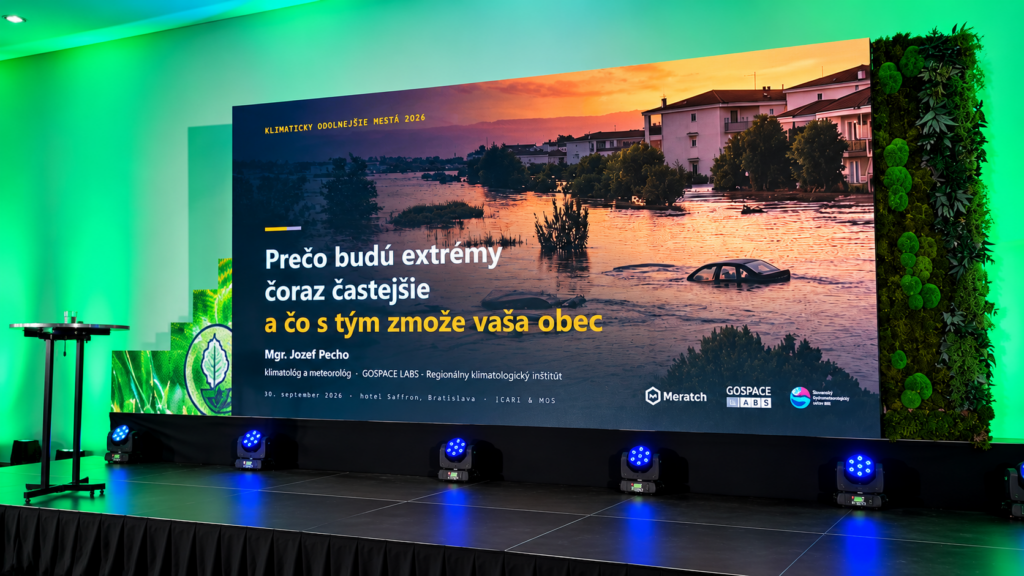
At the end of September, Jozef Pecho, climatologist and meteorologist at Meratch / GOSPACE LABS, took part in the fifth edition of the Climate-Resilient Cities 2026 conference in Bratislava.
The event brought together municipalities, urban planners, researchers, policymakers, and sustainability professionals to discuss practical ways to help cities adapt to heat, drought, heavy rainfall, and other consequences of a changing climate. Its programme focused on climate adaptation planning, green and blue infrastructure, water management, urban resilience, and feasible solutions for the built environment.
Climate data needs a local context
Jozef spoke in the session “The Current Climate Situation Through the Eyes of Generation Z and an Expert Climatologist.” His contribution focused on the growing frequency and intensity of climate extremes, and on what changing temperatures, precipitation patterns, and other climate indicators mean at the level of specific regions and cities.
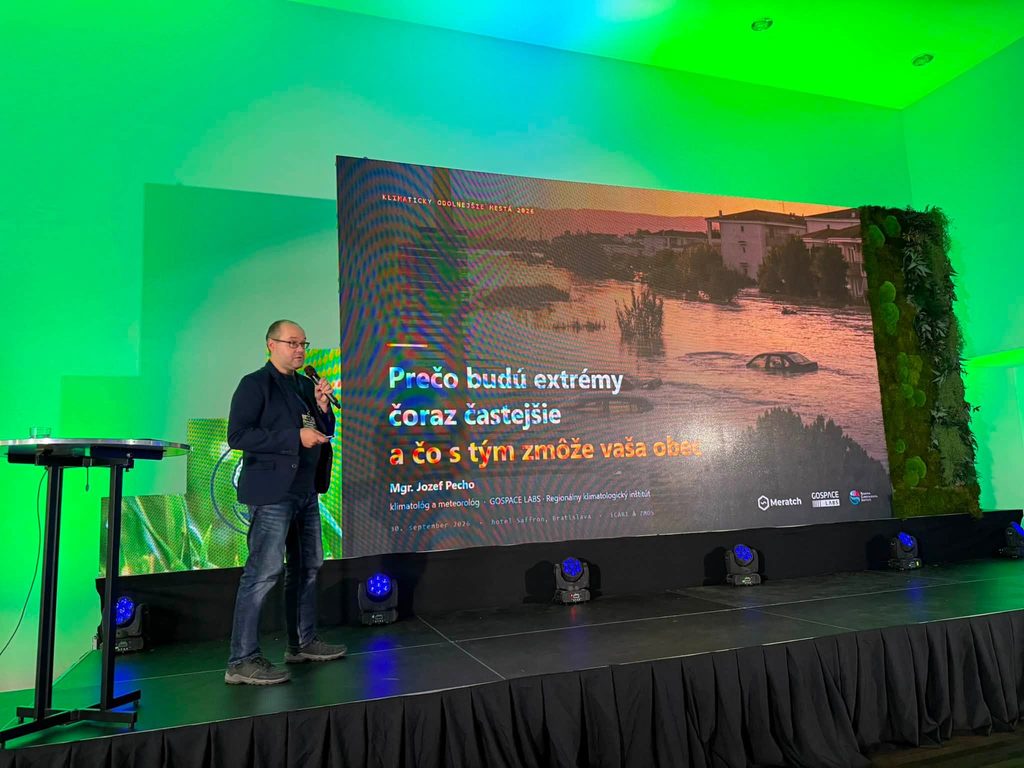
Climate change is often discussed through global averages. But for municipalities, decisions need to be based on local reality: how heat stress is evolving in a particular neighbourhood, where intense rainfall is creating new risks, how dry periods affect water availability, and which climate signals should inform planning and investment.
This local perspective is increasingly essential for cities seeking to move from broad climate commitments to targeted adaptation measures.
From data to practical action
The conference highlighted a challenge that is central to Meratch’s work: cities need more than climate data. They need information that is understandable, location-specific, and usable in day-to-day planning and risk management.
For local governments, this can mean using climate intelligence to:
- identify areas most exposed to urban heat and drought,
- prepare for increasingly intense rainfall and flood risk,
- design effective green and blue infrastructure,
- prioritise investments in resilient public space and infrastructure,
- make adaptation planning more evidence-based.
By joining the discussion in Bratislava, Jozef brought Meratch’s perspective on translating climate and weather data into practical insight for municipalities and other local stakeholders.
About the conference
Climate-Resilient Cities 2026 took place on 30 September 2026 at Hotel Saffron in Bratislava, followed by an excursion on 1 October. The international conference focused primarily on climate adaptation in Central and Eastern Europe and was organised in cooperation with the Association of Towns and Communities of Slovakia (ZMOS).
